Spilhaus Space Clock
I have one of these clocks for sale. Go here for more information.
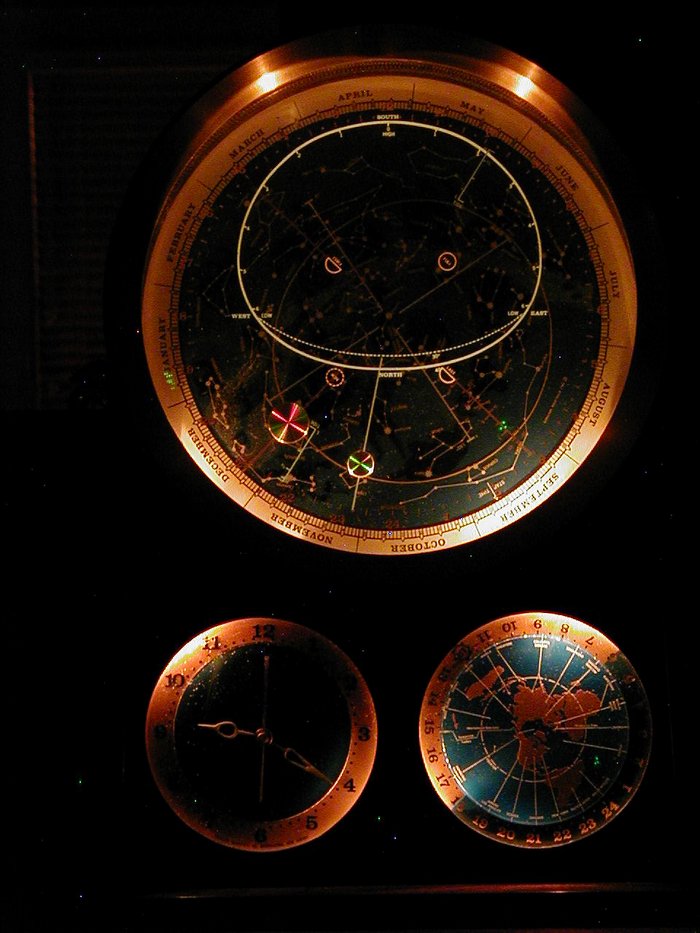
This is the fabulous Spilhaus Space Clock. It was designed by Dr. Athelstan Spilhaus, Dean of Technnology, University of Minnesota (from 1949 to 1967). Dr. Spilhaus was the inventor of the bathythermograph, an invention which contributed substantially to America's submarine warfare success in WW II. Dr. Spilhaus had many areas of interest including oceanography and meteorology. The lower left dial shows regular
time; the lower right dial is a 24 hour clock which shows the time in various major cities around the world. The large Space Dial of the Spilhaus Space Clock presents a
variety of important celestial information. From the large space dial you can read these 15 up-to-the minute facts:
1. The Horizon And The Visible Heavens
2. The Sun's Position In The Sky.
3. The Moon's Position In The Sky
4. Position Of The Stars
5. Relative Position Of Sun, Moon, And Stars
6. A Perpetual Calendar Showing The Current Month And Day
7. Solar Time Of Sun, Moon, And Stars At Meridian
8. Sidereal Or Star Time.
9. Current Phase Of The Moon
10. Time Of Daily Sunrise And Sunset
11. Mean Time Of Moon Rise And Moon Set
12. Mean Time Of Star Rise And Star Set
13. Current Time Of High Or Low Tide
14. Current Stage Of The Tide
15. Mean Solar Time At The clock's Location
See below for a picture and description of each of the five disks. The clock runs on a synchron motor and is extremely accurate. Dr. Splihaus offered the manufacturing rights to Edmund Scientific Co. of Barrington, New Jersey. They began production in 1964 and continued to produce them into the 1970's. Serial numbers go over 2700. The dimensions are approximately 15 inches tall by 10 inches wide. The case is made of solid cherrywood with brass trim and was completely hand-made by a certified clock maker. I have four of these, the first one's serial number is B690, the second is B925, the third is B1352, and the fourth was sold to me as a parts clock. It is missing the large glass and four gears are broken. The power cord is damaged and the light switch has a broken piece. Its serial number is B2719. I found the glass (see below) and fixed the power cord. The light switch is an easy fix too. I sent the four broken gears to Steve Cotton (see below). I'll probably sell it or one of the others. Below are pictures of one of my clocks, B690. The bottom picture shows the nighttime illumination.

Here is a great resource page for these clocks. There is information on shipping, dissassembly, and repair. Michael Sands can even restore these clocks for you: The Sands Mechanical Museum
The biggest problem with these clocks is the gears. They are made of nylon and shrink over time, causing them to crack or break. Thanks to Michael Sands of the Sands Mechanical Museum and Steve Cotton of Micro Precision Parts Manufacturing Ltd. there are now replacement gears available. They are made of delrin, which will not shrink and crack with age. I had Steve make replacements for all eight of the gears in my B1352 clock. They were $35.00 each as of this past summer and the metal bushings that they mount on were an extra $5.00 each (I was missing two). A couple of the gears seemed to be pressed onto the gear shaft. I didn't want to force them and risk breaking anything, so I sent the gear shafts to Steve when I had the gears replaced and he installed them onto the shafts correctly. Contact Steve Cotton at the link above for more information. Some early clocks, such as my B690 and B925, have aluminum gears and thus do not have problems with shrinkage and cracking, although I wonder if the aluminum will wear the plastic teeth on the large disks over time. Mine don't seem to show any visible wear.
I have found replacements for the glass: http://www.norkro.com/ . Scroll down the left column and click on "Glass For Clocks". From that page you can select the size you need: the large space dial glass is 8 3/4" in diameter. The smaller glass is 4 1/4" in diameter. At the time I made this page, the large glass was $10.75 and the small glass was $6.11.
Disks Of The Space Dial
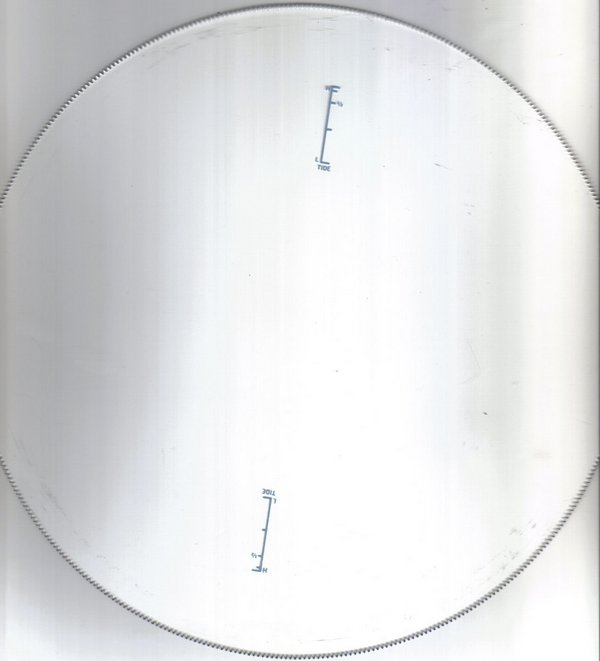
Below are pictures and descriptions of each of the disks visible through the large space dial. These disks are superimposed over one another and are read against each other. The first disk is the tide disk. This disk has two graduated lines. The lines have calibrations that when read against the blue oval on the horizon disk will tell you at what level the tide is and whether you are approaching or passing high tide.
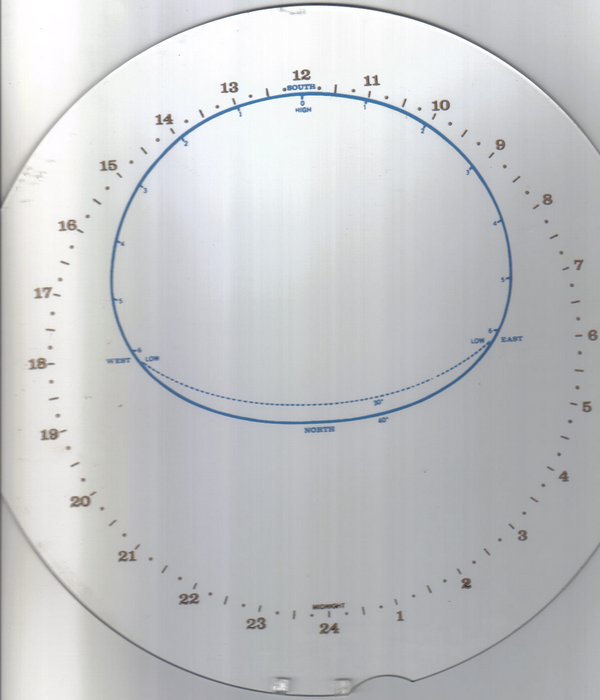
The second disk is the horizon disk. It is fixed in place. It has a large blue oval that the other disks are read against. When the sun disk, moon disk, or the stars on the star disk are within the blue oval, they are visible for viewing in your location. The other disks rotate counter-clockwise so sunrise, moonrise, and starrise will be shown to the right. The edges of the oval have hour increments to show how long before or after high tide it is when read with the tide disk line. Also, printed around the circumference of this disk is a 24 hour clock. The line going through the sun on the sun disk is read against these time increments to show true solar time and the light blue arrow on the stardisk is read against this to show sidereal (star) time.
The third disk is the moondisk. It has a single line with a diffraction grating disk to represent the moon. This disk rotates 50 minutes slower per day than the sundisk. When properly set, you can see the moon's position relative to the sun. When read against the sun dial, the current phase of the moon can be deduced.
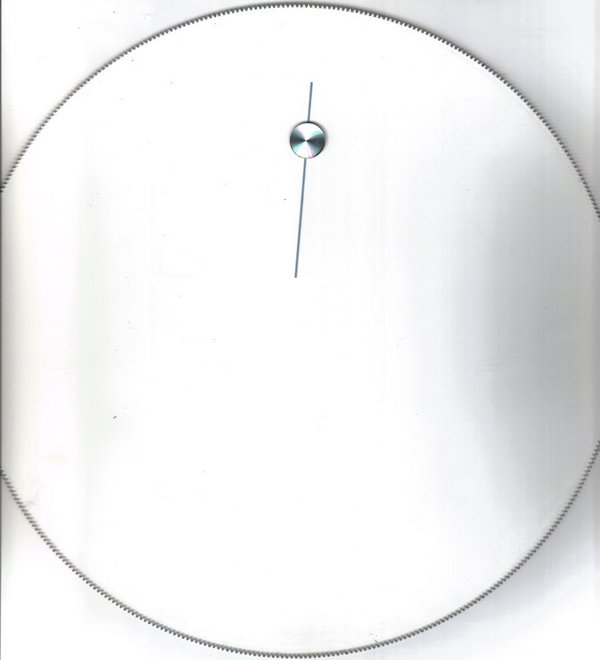
The fourth disk is the sun disk. This disk has three lines, two of which are gratuated. The gold sun line is perpendicular to the two graduated lines and has a larger diffraction grating disk to represent the sun. The gold sun line points to the numbers on the horizon disk to show true solar time and it also points to the perpetual calendar on the edge of the star disk to show the current month and day. The two other gold lines are opposite one another and are graduated in half hour increments. When read against the gold oval on the star disk, sunrise and sunset can be determined. Also on this disk is the phases of the moon.
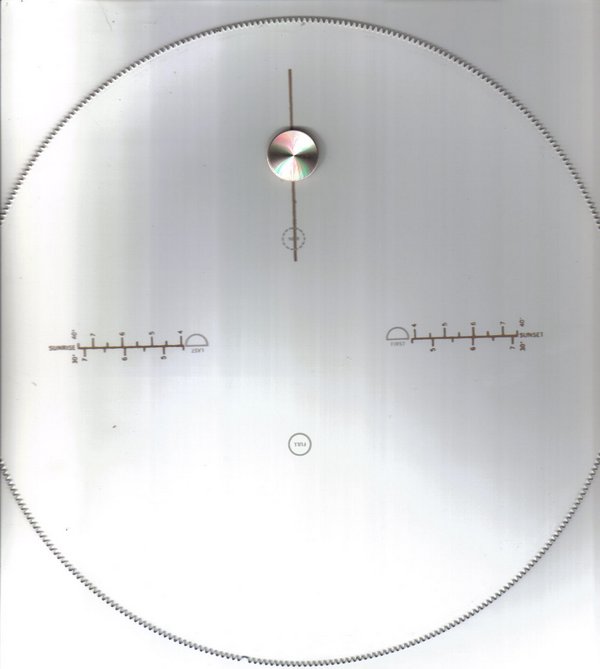
The fifth and final disk is the star and calendar disk. This disk has quite a bit of information on it and the other disks are set relative to it. The outer edge has a perpetual calendar. The sun line points to the day and month. A star chart is printed on the disk. Stars currently visible to you are shown within the blue oval on the horizon disk. A light blue arrow points to sidereal time (read on the horizon disk). Also, there is a gold oval used as a reference for reading sunrise and sunset with the graduated lines on the sun disk.

Updated March 5, 2008